
Onsite LNG storage and supply for data center power
Fuel on site. Before the pipeline, after the grid.
Grid interconnection averages 5.2 years. New LNG tanks take 12–18 months. A CryoSurge storage module ships in 60–120 days, runs your gas generation as primary supply now, and stays as compliant backup once the pipeline connects.
Your generators are ready. The gas is not.
Data centers are being built faster than utilities and pipelines can connect them. PJM interconnection averages 5.2 years; Dominion quotes about 7 years for a 100 MW hookup; ERCOT took 198 GW of large-load applications in one quarter. Meanwhile downtime costs large enterprises more than $300,000 an hour.
Diesel cannot be the bridge
The EPA caps non-emergency diesel generator use at 50 hours a year. California's SB 887 and SB 978, Washington's 25-hour cap at Sabey, and New York's moratorium go further. Diesel fuel degrades in 6–12 months and needs polishing. LNG does not degrade, permits on 40–70% lower emissions, and can run as long as the permit allows.
New tanks cannot be the bridge either
A new cryogenic tank quotes 12–18 months and $250,000–350,000 under the 2025 tariff stack. LNGVault's fleet of 30 decommissioned LNG terminals is already in the country, refurbished and recertified into standardized CryoSurge modules at roughly 35% below new.
Lease it, own it, fuel it, or hand us the whole fuel side.
Storage lease
A CryoSurge module on your pad for 5–10 years, permitted, commissioned, and maintained by us. Buy out at residual, extend, or return.
Turnkey sale + EPC
Own the module at list price and let LNGVault deliver the fuel yard: engineering, NFPA 59A permitting support, installation, commissioning.
Fuel supply
Scheduled LNG deliveries from CNGdelivery's trailer fleet with a contracted minimum inventory. The buffer that makes a virtual pipeline bankable.
Power-as-a-Service bundle
One monthly fee for storage, fuel, and service, with generation through a named partner. One contract, one guarantee on the fuel side.
Two standardized modules. Any scale.
Each CryoSurge module combines vertical 18,000-gallon cryogenic tanks, ACD TC-34 submersible pumps, CryoQuip ambient vaporizers, cryogenic interconnect piping, and a control container running Allen-Bradley CompactLogix and GuardLogix safety PLCs. Modules arrive pre-engineered with site layouts modeled to NFPA 59A setbacks.
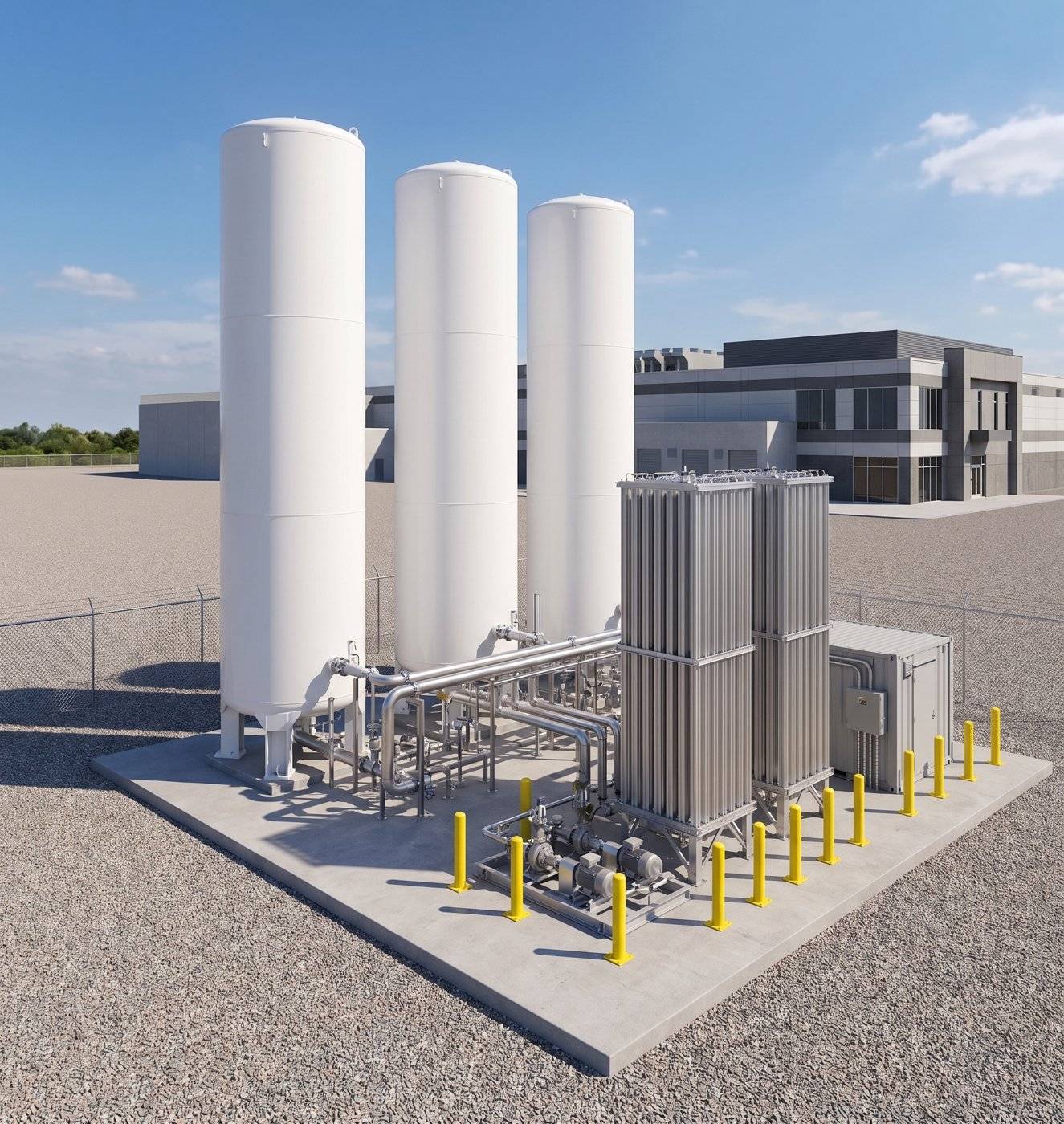
CryoSurge 3T
| Usable LNG | 45,000 gal |
| Stored gas | 3,690 MCF |
| Net electric energy | 436 MWh |
| Runtime at 25 / 50 / 100 MW | 17.4 / 8.7 / 4.4 h |
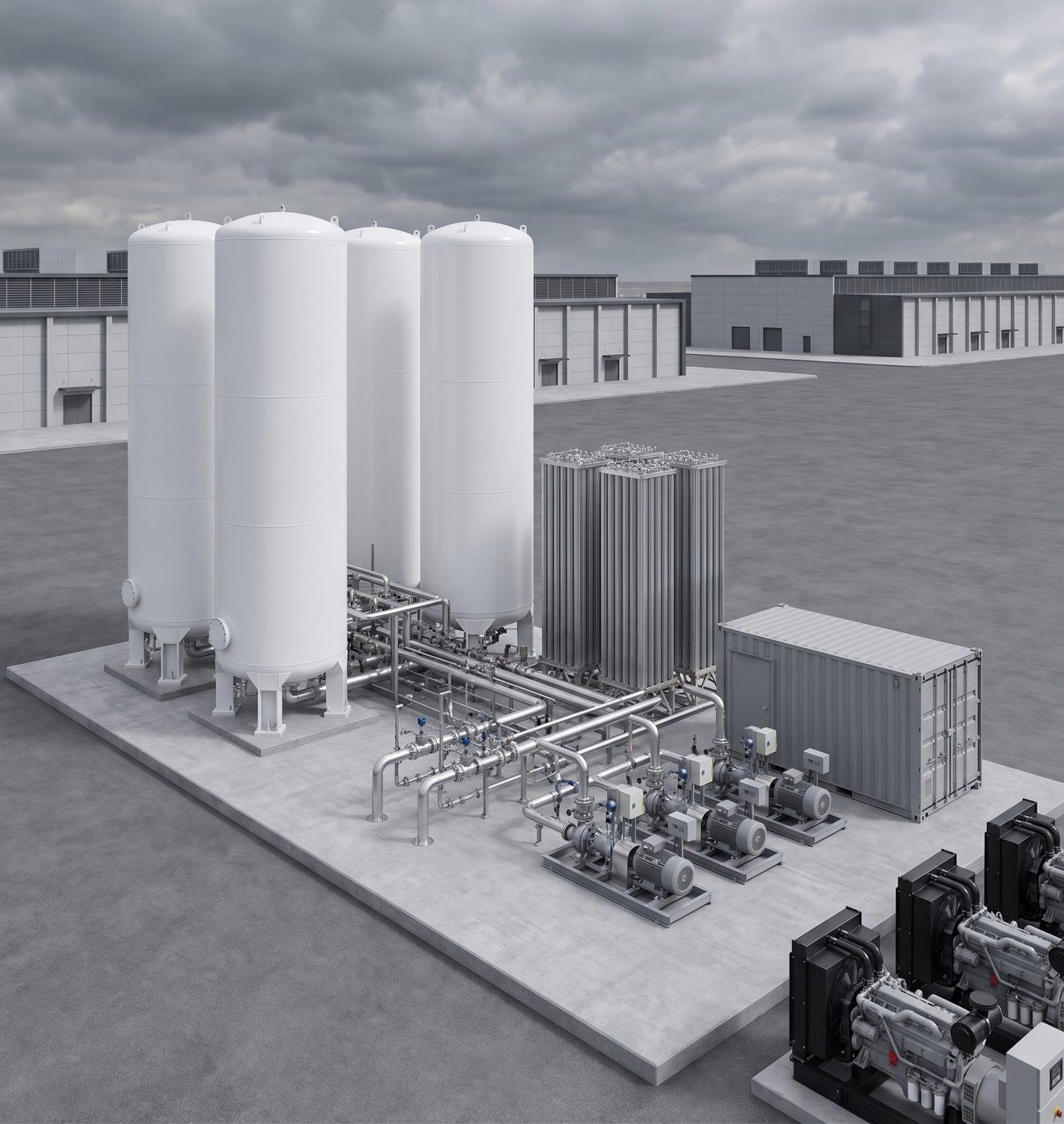
CryoSurge 4T
| Usable LNG | 60,800 gal |
| Stored gas | 5,022 MCF |
| Net electric energy | 581.3 MWh |
| Runtime at 25 / 50 / 100 MW | 23.4 / 11.6 / 5.8 h |
Primary gas today. Backup tomorrow.
Bridge to the pipeline
Your interconnection is years away, but generation must run now. CryoSurge is the primary gas source, replenished by scheduled trailer deliveries. When the pipeline connects, the modules stay as permanent backup. The asset changes mission; it never strands.
Buffer for trailer-delivered fuel
A 50 MW plant needs 12–13 trailer deliveries a day, 25 or more at 100 MW. One late truck can starve the turbines. One CryoSurge 4T carries 11.6 hours at 50 MW while trailers cycle.
Tier III/IV backup without diesel
Where diesel hours are capped, LNG storage gives 24-hour or multi-day fuel autonomy with active boil-off management, so the fuel holds without venting until it is needed.

Concept render: CryoSurge module bridging supply between trailer deliveries.
A CNGdelivery company, built on a fleet that already exists.
LNGVault is the division of CNGdelivery that owns the storage side of behind-the-meter gas power. CNGdelivery runs the virtual pipeline: CNG and LNG delivered by trailer to industrial sites without pipeline gas. LNGVault adds the tank at the end of it.
The modules come from 30 decommissioned LNG vehicle-fueling terminals owned by Gas Equipment 4 Sale, refurbished with Markey Cryo and CCH Equipment: 450,000 gallons of tank capacity, about 125 ACD pumps, more than 40 vaporizers, and 16 brand-new PLC control containers. See the fleet.